


Gym Flooring
Gym flooring
Gym Flooring For Commercial & Home Gyms
Heavy-duty rubber gym tiles for gyms, PT studios, schools and residential developments. Here's how to choose the right thickness for each part of your space, and how we can specify and quote it for you.
Choose Your Thickness
Three thicknesses cover almost every gym. Thicker tiles take heavier drops and absorb more impact and noise, so most gyms use more than one.
| Spec | 20mm | 30mm | 43mm |
|---|---|---|---|
| Max weight drop | 140kg | 200kg | 250kg |
| Best for | General gym floors, functional training | Heavier lifting, extra noise reduction | Olympic lifting, high-impact zones |
| Tile size | 1m × 1m | 1m × 1m | 1m × 1m |
| Base | Flat | Flat | Studded |
| Edge | Bevel edge | ||
| Material | Recycled SBR rubber granules (70% from truck tyres) bonded with polyurethane | ||
| Density | 950–1,000kg/m³ | ||
| Slip resistance | 105 PTV dry, 75 PTV wet (EN 13036-4) | ||
| Hardness | 55–75 (ISO 868) | ||
| Abrasion resistance | 560 or less (EN ISO 5470-1) | ||
| Fire rating | Efl-s1 (EN 13501-1) | ||
| Certification | CE marked, REACH compliant | ||
| Tolerances | ±2% length and width, ±5% thickness | ||
| Warranty | 4 years | ||
| Colour | Black | ||
Drop ratings are the manufacturer's guide figures. Technical data is from the manufacturer's spec sheets for each thickness (Sprung PRO range, February 2026). Ask us if you'd like a copy. This is our commercial flooring range, which is a different spec from the tiles in our online shop.
How Many Tiles Do You Need?
Enter your room size. Each tile covers 1m², and we add 10% for cuts.
Three Questions Before You Choose
Answer these and you'll know which thickness each part of your floor needs.
Not what's lifted, what's dropped. A missed deadlift or a bar dumped from overhead hits the floor much harder than a controlled squat. Plan for the impact, then add a margin.
Concrete is the easy case: flat, dry and forgiving. Timber floors, especially upstairs, flex and pass on vibration. Damp ground floors suit the 43mm tile's studded base, which lets moisture move rather than sit under the tile.
Thicker tiles soften the thud of impact, but vibration through the structure is only partly solved by flooring. If there are homes or offices nearby, plan dedicated lifting areas and the thickest tile you can justify.
Flooring By Space
Busy floors with free weights, machines and functional areas. Zone the floor rather than using one tile everywhere.
Our pick: 20mm across the main floor and under cardio and machines, 30mm or 43mm under racks and in lifting zones.Mixed training, client-facing finish and often a shared building. A clean, tight-fitting tile floor with a heavier lifting area.
Our pick: 20mm general, 30mm under racks and free weights.Residents' gyms, hotels and mixed-use buildings, where noise and impact are the first consideration.
Our pick: 30mm or 43mm throughout, with dedicated lifting areas.Strength and conditioning with Olympic lifting, heavy drops and high usage.
Our pick: 43mm in lifting zones, 20mm or 30mm elsewhere.Usually a concrete base. 20mm covers most strength training; step up if you lift heavy or drop the bar from overhead.
Our pick: 20mm, or 30mm for heavy barbell work.Older garages, basements and ground floors that get condensation, even where the training itself is light.
Our pick: 43mm. Its studded base leaves an air gap so moisture can move under the tile rather than sit trapped against the floor.Looking For Something More Bespoke?
Our standard tiles cover most gyms, but if you're after a different look or spec, we can source other styles for your project, for example a different colour, finish or thickness.
Tell us what you have in mind and we'll find options and quote them for you.
Flooring quotes
Tell Us About Your Space
Send us your room sizes or floor plan and how the space will be used. We'll recommend a spec for each zone and send an itemised quote for supply, delivery and installation if you need it.
How Flooring Quotes Work
- Send your details. Room sizes or a floor plan, how each area will be used, what's underneath and your timescales.
- Get your quote. We recommend the thickness for each zone and send an itemised quote for the flooring, delivery and installation if needed.
- Samples on request. Want to see the tiles first? We can arrange samples.
- Delivery and installation. Tiles arrive on a pallet, and our installation partners can lay the floor for you.
When Rubber Tiles Aren't The Answer
Rubber tiles suit most gym floors, but not every area. Zone your floor and spend the budget where it matters: thicker tiles under racks and in lifting areas, thinner surfaces where nothing gets dropped.
Rubber tiles are too firm for floor-based mobility work. Mats or a softer surface are more comfortable.
A dedicated lifting platform handles heavy working sets best. Tiles cover the rest of the floor.
Treadmills, bikes and rowers don't need heavy-impact tiles, so a thinner surface can do the job for less.
These tiles are made for indoor use. Covered spaces are usually fine; areas open to the weather are not.
Installation & Care
Laying the tiles. The tiles are dry-laid onto a clean, level subfloor, with no adhesive or specialist tools needed for a standard installation. Let them acclimatise in the room for 24 hours first. Then lay them from the centre of the room outwards in a half-brick pattern rather than a straight grid: it gives a cleaner finish and reduces movement at the seams, so corners are less likely to creep apart. Butt the tiles tightly together, then compress and trim the edges, and add ramps where the floor meets a doorway or another surface.
Cutting. Use a sharp utility knife and a metal straight edge, scoring the line several times rather than cutting in one pass. Dense rubber blunts blades quickly, so have spares. For 43mm tiles, several deep passes or a jigsaw with a coarse blade works best. Always cut on a scrap board.
Cleaning. Vacuum or sweep regularly and damp mop with a pH-neutral cleaner. For a deep clean, machine scrub with an approved floor cleaner. Avoid harsh solvents, bleach and abrasive cleaners, which break down the binder over time.
Want it fitted for you? We can quote for installation by our partners.
Flooring On Our Projects
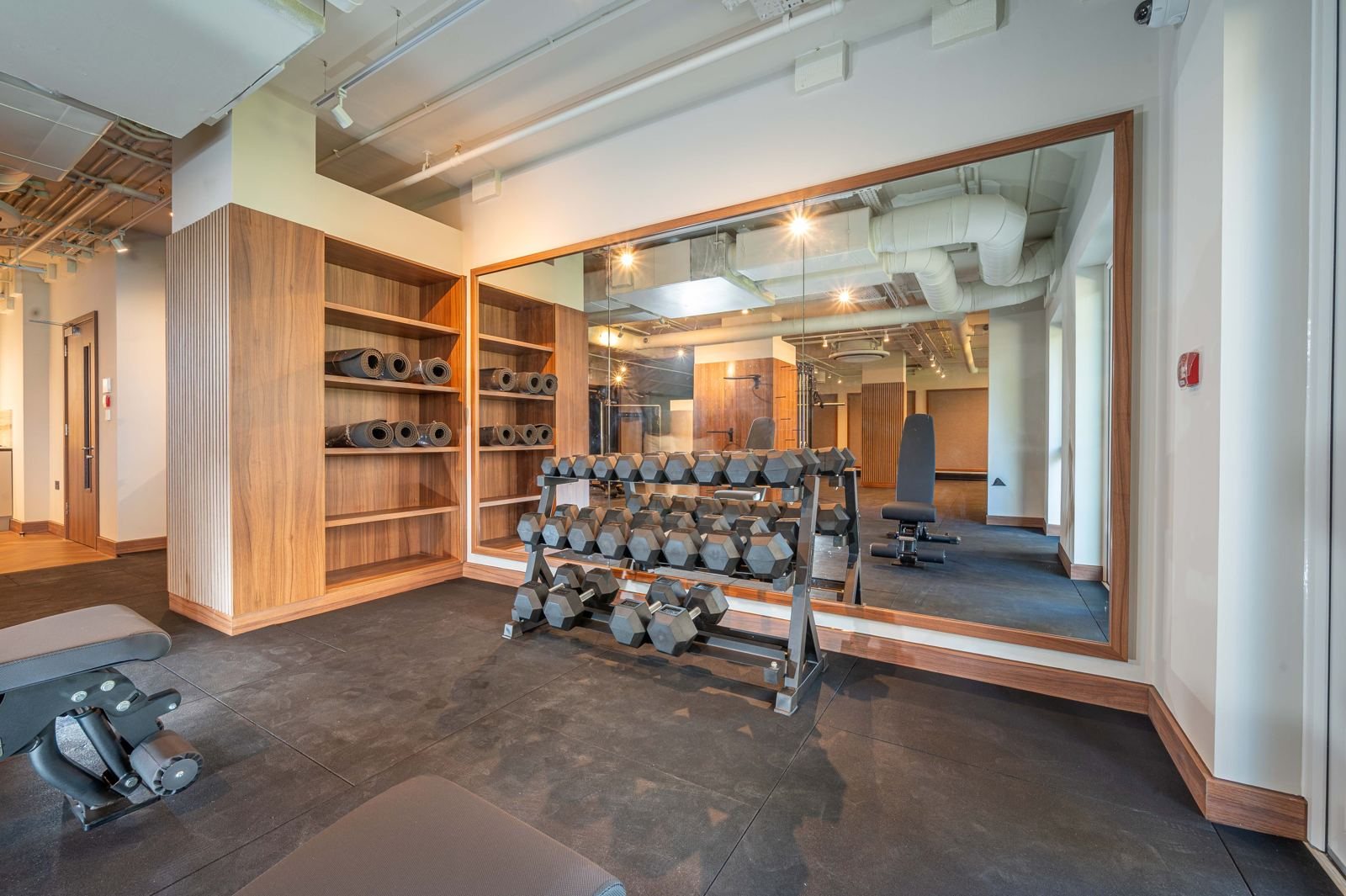
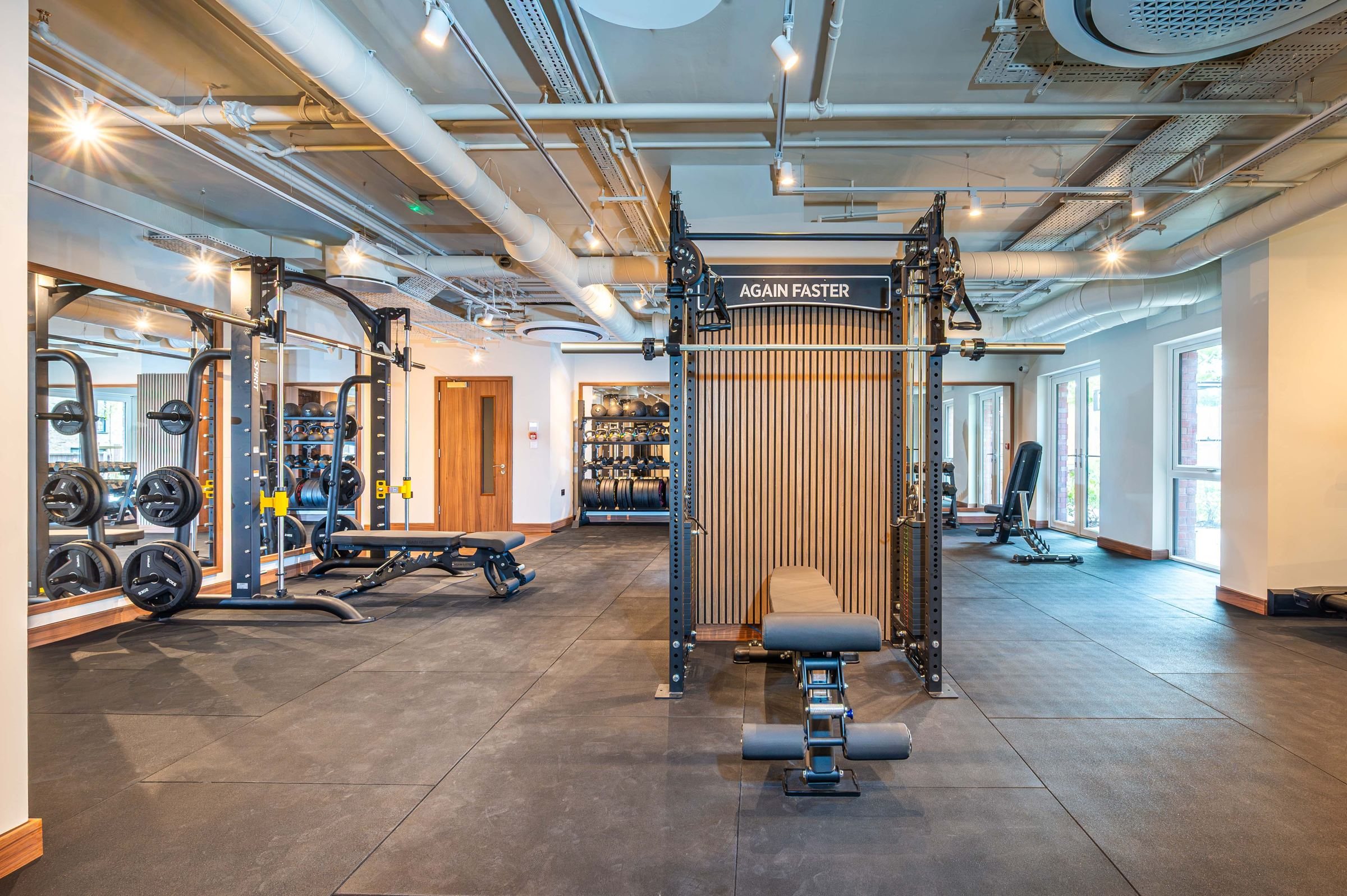
For a build-to-rent residents' gym in Watford, we specified 115m² of 30mm acoustic rubber tiles to protect the cinema and apartments above, as part of a turnkey fit-out.
 Build-to-rent
 Sport & education
 Independent gyms
Fitting out a whole gym? See our gym design service, or plan your layout with our free 3D gym planner.
Request A Flooring Quote
Tell us about your space and we'll get back to you within 48 hours (Monday to Friday).
- Include your room sizes or floor plan, what's underneath, and how each area will be used.
- We'll recommend a spec and send an itemised quote.
- Need it fitted? We'll include installation by our partners.
Prefer to talk? Book a call or email [email protected].
Gym Flooring FAQs
Can I see a sample before I order?
Yes. We can arrange sample tiles on request. Just ask when you send your enquiry.
What warranty do the tiles have?
Our commercial flooring tiles come with a 4-year manufacturer's warranty. Ask us for the full warranty terms with your quote.
Do you install the flooring?
We supply the flooring and can quote for installation by our installation partners, so you get one quote for the whole job. Many customers also lay the tiles themselves; see the installation tips above.
Do the tiles need gluing down?
No. For a standard installation the tiles are dry-laid onto a clean, level subfloor. Their weight, a tight fit and a half-brick pattern hold them in place.
What does the drop rating mean?
It's the weight that can be dropped onto the tile, not what it can hold. Racks, machines and dumbbell storage sitting on the floor put far less stress on a tile than a dropped barbell. Our drop ratings are the manufacturer's guide figures.
Can I lay the tiles on concrete or timber?
Concrete is the ideal base: flat, dry and stable. Sweep it clean first, as grit under a tile creates uneven spots. Timber floors, especially upstairs, flex and pass on vibration, so go thicker and check floor loading with your landlord or a structural engineer.
Will the tiles smell?
A faint rubber smell when the tiles are unpacked is normal and fades with ventilation over the first few days.
Are the tiles waterproof?
They're water-resistant, so they're fine in garages and gyms where condensation and spills happen. They aren't designed for standing water or for outdoor areas exposed to the weather.
How many tiles should I order?
Each tile covers 1m². Work out your floor area and add around 10% for cuts, more if the room has lots of corners or pillars. Use the calculator above, or send us your floor plan and we'll work it out.
How is the flooring delivered?
Tiles are delivered on a pallet, kerbside. Let us know about any access restrictions, as a lorry will need to reach the property. See our pallet delivery terms.
Is this the same as the tiles in your online shop?
No. This is our commercial flooring range, specified and quoted per project. Send us your details and we'll quote the right spec for your space. For a few tiles for a home gym, see the tiles in our online shop.