


When setting up a gym, it’s crucial to choose equipment that aligns with your fitness goals and offers versatility to adapt as your workouts evolve. There’s often debate over whether a power rack or squat rack is the better choice as a foundational piece of home gym equipment.
While both have their benefits, they each serve unique purposes and come with distinct advantages. If you’re wondering whether you can save on cost while still getting a highly effective piece of equipment, this article will help you understand the differences between a power rack and a squat rack—and guide you in choosing the best option for your training needs.
Let’s get started.
What is a Power Rack?
A power rack is a comprehensive, cage-like structure with four vertical posts connected by crossbars, creating a stable, enclosed frame. It comes with adjustable safety bars and J-hooks, allowing for a broad range of exercises that typically involve heavier weights. One of the main appeals of a power rack is its versatility and safety. You can use it for compound lifts like squats, bench presses, deadlifts, and overhead presses, and it provides secure support with safety catch bars.What is a Squat Rack?
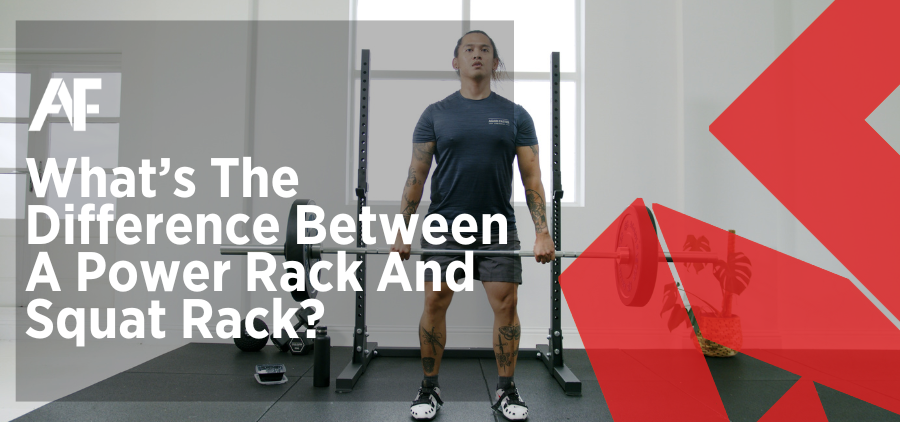
A squat rack or squat stand is a more compact setup, typically consisting of two upright posts with adjustable barbell holders. Some squat racks, often called “half racks,” offer a little more stability and come with additional support arms or spotter arms. Squat racks are mainly designed for squat exercises (as the name would suggest!) but can also be used for some pressing movements, such as bench presses or shoulder presses. However, squat racks lack the fully enclosed structure of a power rack, which limits the safety features available. They’re often a preferred choice for those with limited space and maybe a more budget-friendly option as you get started. Exercises that can be effectively performed in a squat rack include squats, bench presses, and overhead presses, though with fewer safety features than a power rack.Key Differences: Power Rack vs. Squat Rack Which is Best?
| Feature | Power Rack | Squat Rack |
|---|---|---|
| Structure | Four-post, cage-like with crossbars | Two upright posts, open structure |
| Safety Features | Safety bars, spotter arms, and adjustable J-hooks | Fewer safety features, some spotter arms |
| Exercises | Full-body compound exercises | Primarily squats and presses |
| Versatility | High, with options for attachments | Limited, focused on lower body and presses |
| Space Requirement | Requires more space | Compact, suitable for smaller spaces |
Choosing between a power rack and a squat rack depends on several factors, including the range of exercises you plan to do, your training environment, safety needs, long-term fitness goals, and budget.
1. Range of Exercises
If you’re looking for maximum versatility, a power rack is ideal. The enclosed frame and safety features allow for a broader range of exercises, including squats, deadlifts, bench presses, and pull-ups. A squat rack, while useful, is more limited and is best suited for squats and overhead pressing movements. Which is best depends on your training plans, but remember to think ahead and future-proof against future fitness goals too.- Best for Range of Exercises: Power Rack
2. Safety for At-Home and Solo Training
For those who lift alone or at home, safety is a top priority. Power racks come with adjustable safety bars, which catch the barbell if you fail a lift, providing peace of mind during heavy lifts. Squat racks also offer safety support with only the most robust models featuring spotter arms.- Best for Safety: Both, depending on the lift
3. Versatility for Long-Term Fitness Goals
A power rack offers exceptional versatility and adaptability for long-term fitness goals. Whether you’re just starting or already experienced, a power rack can accommodate changing fitness needs. The ability to add attachments, such as dip bars or resistance bands, allows you to expand your workout options. Squat racks are highly effective for a few exercises but are less versatile. For some, that’s no problem at all, but factor it into your thinking.- Best for Long-Term Versatility: Power Rack
4. Cost and Space Considerations
For those with a tighter budget or limited space, a squat rack can be a practical choice. It takes up less space than a power rack and can still accommodate many essential exercises. Power racks, while larger and typically more expensive, are an investment that provides a safer and more versatile training experience. They also remove the need for more solo pieces of equipment to perform a broader range of exercises.- Best for Budget and Space Efficiency: Squat Rack
Investing in a Power Rack from Again Faster
If you’re leaning toward a power rack, Again Faster offers elite-level options built with quality and performance in mind. Trusted by athletes and fitness professionals, their power racks combine durability, safety, and versatility, providing an excellent solution for anyone looking to improve their strength training setup.- Rival Power Rack: The Rival Power Rack is built to maximise space efficiency while offering robust safety features, including adjustable J-hooks and safety bars. It’s designed to provide everything you need for comprehensive strength training in a compact form, making it suitable for home gym setups.
- Competition Power Rack: This rack is built to withstand intense use and comes with enhanced durability and weight capacity, catering to advanced athletes and dedicated strength trainers. The Competition Power Rack supports a range of exercises with additional options for attachments, making it a versatile choice for serious training.